LAGOS PRESENTS PROVISIONAL APPROVAL TO 101 PRIVATE SCHOOLS, REAFFIRMS COMMITMENT TO QUALITY EDUCATION
…Warns Against Unqualified Teachers, Concealment of Abuse; Introduces QR Code Verification
The Lagos State Government has reaffirmed its commitment to creating an enabling environment for private schools to thrive while strengthening regulatory oversight to ensure quality education, child safety and compliance with established standards.
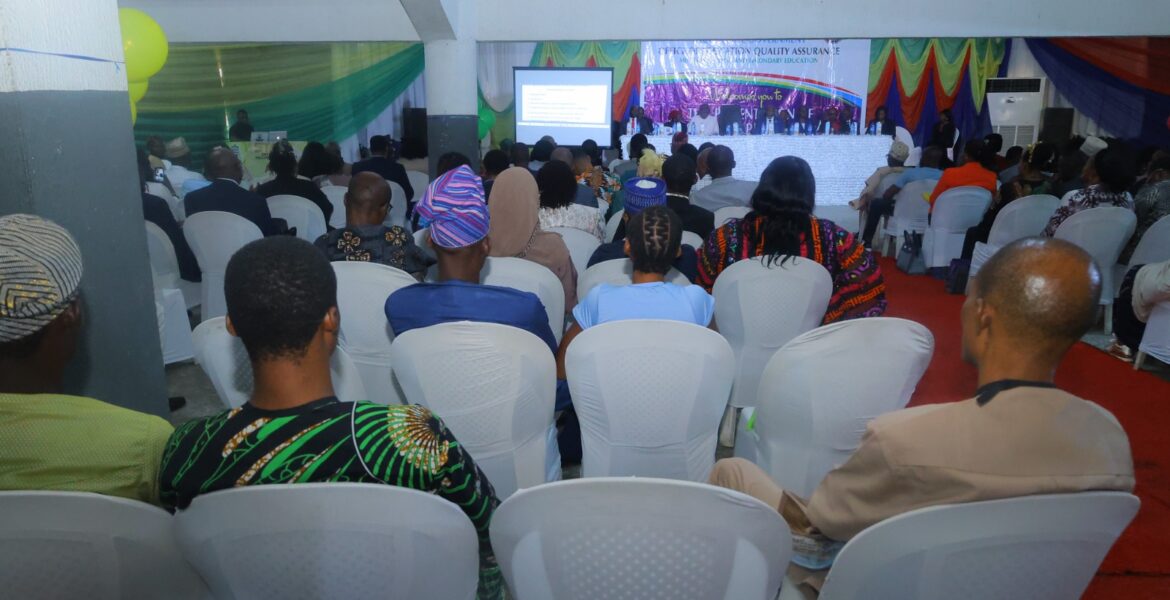
The Commissioner for Basic and Secondary Education, Mr. Jamiu Tolani Alli-Balogun, stated this on Thursday during the presentation of provisional approval letters to 101 private schools at the NUT Pavilion, Alausa, Ikeja.
Alli-Balogun described private school proprietors as strategic partners in the development of education in Lagos, noting that the State Government would continue to promote collaboration and provide the necessary support for private educational institutions to improve their operations and deliver quality services.
He attributed the progress recorded in the sector to the government’s proactive policies, effective regulation and commitment to education as a major pillar of the T.H.E.M.E.S Plus Agenda of Governor Babajide Olusola Sanwo-Olu.
According to the Commissioner, the presentation of provisional approval letters marks the beginning of a formal relationship between the Ministry and the newly approved schools, with an expectation that proprietors will operate in accordance with the Lagos State Education Law, the Child Rights Act and other relevant regulations.
He urged school owners to invest in their facilities, improve their human resources and engage qualified teachers, stressing that the provision of quality education requires adequate infrastructure, competent personnel and strict adherence to professional standards.
The Commissioner also outlined the Ministry’s commitment to regular monitoring and guidance through the Office of Education Quality Assurance (OEQA), assuring proprietors that the government would continue to provide information and support to help them meet required standards and align their operations with global best practices.
He encouraged school owners to regard their institutions as part of a collective responsibility rather than isolated private ventures, emphasising that government and private education providers must work together to build a strong and sustainable education system.
Alli-Balogun further cautioned proprietors against concealing incidents of child abuse, molestation and bullying, directing them to report such cases promptly to the appropriate authorities. He warned that failure to comply with child protection requirements could attract serious sanctions.
Earlier, the Director-General of OEQA, Dr. Sulaimon Olagoke Ogunmuyiwa, described the presentation as an important step towards strengthening quality assurance and ensuring that private schools in Lagos operate within established regulatory frameworks.
Ogunmuyiwa disclosed that the 101 schools comprised 63 nursery and primary schools, 35 secondary schools, two sixth-form schools and one boarding school. He explained that the exercise was designed to support genuine school proprietors while ensuring that all institutions meet the standards required for effective teaching and learning.
As part of measures to protect the integrity of the approval process, the Director-General announced the introduction of QR codes on provisional approval letters to enable verification of their authenticity and prevent the circulation and use of counterfeit documents.
He also revealed that OEQA had developed an automated school registration and approval process, which was awaiting the Governor’s approval. According to him, the proposed system would simplify applications, enable online submission of documents, reduce repeated visits to the Ministry and allow proprietors to track the progress of their applications more conveniently.
Ogunmuyiwa congratulated the newly approved schools and reminded their proprietors that provisional approval came with the responsibility to maintain appropriate standards, provide safe learning environments, engage qualified teachers and fulfil all outstanding requirements. He reiterated the agency’s zero-tolerance stance on falsified documents and deliberate violations of established guidelines.
In a related development, the Director of Schools Standard and Evaluation at OEQA, Mr. Amos Fajobi, urged the newly approved schools to commence the Subject Recognition Inspection (SRI) process, explaining that provisional approval alone did not automatically qualify a school to serve as an external examination centre.
He noted that SRI validates the subjects a school is qualified to offer, with the resulting report forwarded to the West African Examinations Council (WAEC), the National Examinations Council (NECO) and the Lagos State Examinations Board for consideration.
Fajobi encouraged proprietors to take advantage of the period between the presentation of their approval letters and December to complete the process. He explained that the inspection could be completed within two weeks of receiving the provisional approval letter, provided the school met the necessary requirements.
He added that early completion would help eligible schools work towards securing recognition to present their candidates for WAEC, NECO and the Basic Education Certificate Examination (BECE) in their own facilities, subject to the approval of the relevant examination bodies.
In her remarks, the Director of Private Education and Special Programmes, Mrs. Kehinde Ogunlana, commended the management and staff of OEQA for their cooperation and commitment to ensuring a smooth approval process.
She noted that effective collaboration between the Ministry, OEQA and private school proprietors was essential to building a well-regulated education sector where schools could operate successfully while meeting the standards required to protect learners and improve educational outcomes.
Ogunlana urged the newly approved proprietors to sustain their engagement with OEQA, comply with regulatory requirements and seek clarification whenever necessary, stressing that the provisional approval should serve as a foundation for continuous improvement rather than the end of the compliance process.
She also encouraged school owners to maintain open communication with the relevant authorities and embrace the guidance provided by the Office, noting that a shared commitment to quality, accountability and child welfare would strengthen confidence in private education across Lagos State.
The event was attended by Coordinating Directors of the six Education Districts, heads of departments at OEQA, representatives of the Lagos State Examinations Board and the Lagos State Universal Basic Education Board (LASUBEB), as well as other stakeholders in the education sector.
Adepeju Adeyemi
Director, Public Affairs (OEQA)
16 October 2026